
Mem0 Alternatives in 2026: 8 AI Memory Tools Compared
Why teams look past Mem0, what each alternative does better, and how to migrate.
Disclosure: Membase is our product. We list it first because it’s the alternative we know best, and we say plainly where Mem0 or another tool is the better fit. Prices, licenses and features were checked on vendor pages, docs and GitHub in October 2026; see “How we compared” at the end.
- Quick links: Get a free Membase API key · Python SDK · MCP server · Docs · GitHub
TL;DR
- Teams usually look past Mem0 for one of five reasons: graph memory costs $249 a month, graph memory left the open-source SDK, v3 keeps contradicting facts side by side, retrieval quotas run out once several agents share a project, or memory has to reach beyond one app.
- Membase by Unibase: one memory your agents and your AI tools (Claude Code, Cursor, Codex, ChatGPT) all read. Free in beta.
- Zep / Graphiti: facts that change over time.
- Letta: agents that manage their own memory.
- Hindsight or Cognee: self-hosted, graph-style retrieval without a paywall.
- Supermemory: managed memory with data connectors.
- LangMem: you’re already on LangGraph.
- Honcho: preferences users never state.
- Stay on Mem0 if you run a multi-tenant app that needs per-user memory and want the fastest setup.
Why teams look for a Mem0 alternative
Mem0 is the most widely used memory layer for AI agents, and for many apps it’s still a good choice. These are the reasons teams look elsewhere.
1. Graph memory sits on the $249 Pro plan. Hobby is free (10K add requests and 1K retrievals a month), Starter is $19, and graph memory (“entity linking”) is listed on Pro at $249 a month. That’s a 13× step for one feature. (Mem0 pricing)
2. Graph memory left the open-source SDK. Mem0’s v2-to-v3 migration guide says: “Graph memory is removed from the open-source SDK.” The Neo4j, Memgraph, Kuzu, Apache AGE and Neptune code paths are gone. (Mem0 migration guide)
3. Contradicting facts are kept side by side. v3 extraction is “Single-pass ADD-only (one LLM call, no UPDATE/DELETE).” In Mem0’s words, “When information changes, the new fact is stored alongside the old one,” and retrieval ranking decides which surfaces. If a user moves from Postgres to MySQL, both facts stay in memory. (Mem0 migration guide)
4. Retrieval quotas run out with several agents. Retrievals are capped at 1K a month on Hobby, 5K on Starter and 50K on Pro. Ten agents doing 20 lookups a day use about 6K a month, which is already past Starter. (Mem0 pricing)
5. Memory stays inside one app. Mem0 scopes memory to a user, agent, session or app inside your application. Sharing what one agent learned with another agent, or with the AI tools your team uses every day, takes extra plumbing.
A note on benchmarks. Mem0 reports 92.5% on LoCoMo and 94.4% on LongMemEval on its platform; an independent evaluation cited by Vectorize measured 49.0% on LongMemEval. Results swing with the reader model, judge and settings, so test on your own data.
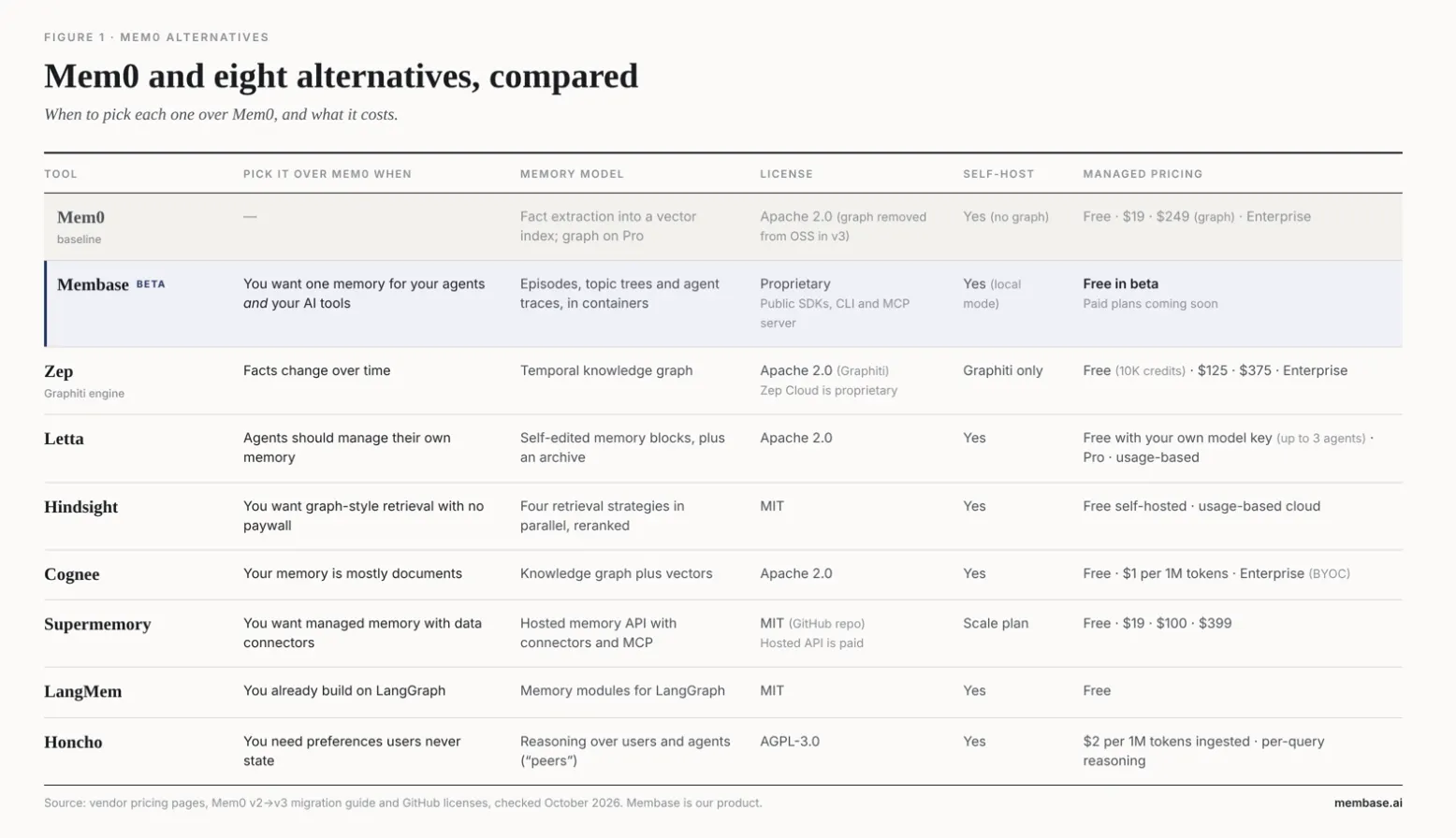
Mem0 alternatives at a glance
- Membase (beta): pick it when you want one memory for your agents and your AI tools. Episodes, topic trees and agent traces, in containers. Proprietary license; SDKs, CLI and MCP server are public. Self-host: yes (local mode). Free in beta · Paid plans coming soon.
- Zep / Graphiti: pick it when facts change over time. Temporal knowledge graph. Graphiti is Apache 2.0; Zep Cloud is proprietary. Self-host: Graphiti only. Free (10K credits) · $125 · $375 · Enterprise.
- Letta: pick it when agents should manage their own memory. Self-edited memory blocks plus an archive. Apache 2.0. Self-host: yes. Free with your own model key (up to 3 agents) · Pro · usage-based.
- Hindsight: pick it for graph-style retrieval with no paywall. Four retrieval strategies in parallel, reranked. MIT. Self-host: yes. Free self-hosted · usage-based cloud.
- Cognee: pick it when your memory is mostly documents. Knowledge graph plus vectors. Apache 2.0. Self-host: yes. Free · $1 per 1M tokens · Enterprise (BYOC).
- Supermemory: pick it for managed memory with data connectors. Hosted API with connectors and MCP. MIT repo; hosted API is paid. Self-host: Scale plan. Free · $19 · $100 · $399.
- LangMem: pick it if you already build on LangGraph. Memory modules for LangGraph. MIT. Self-host: yes. Free.
- Honcho: pick it for preferences users never state. Reasoning over users and agents (“peers”). AGPL-3.0. Self-host: yes. $2 per 1M tokens ingested plus per-query reasoning.
1. Membase: one memory for your agents and your AI tools
Membase, built by Unibase, is a memory layer that both your own code and the AI tools you already use can read. Add facts, documents, web pages and chat exports once; your agents, Claude Code, Cursor, Codex and ChatGPT then read the same memory through the SDK, REST or the MCP server.
Why pick it over Mem0
- Memory that isn’t locked inside one app. Mem0 gives your application memory. Membase gives memory to your application and the AI tools around it. The support agent writes call notes with the SDK, and Claude Code answers from the same notes over MCP. The Chrome extension also saves context from ChatGPT, Claude, Gemini, Grok, DeepSeek and Kimi into it.
- Built for several agents. Point every agent at the same memory (container), each with its own key. A key has a level, such as read and write, and a reach: which memories it can use. Revoke one agent without touching the others.
- Answers you can trace. Every search result comes back with the memory and the source file it was learned from.
- A local mode. pip install 'unibaseio-membase[local]' runs memory on your machine with OpenAI, Anthropic, Ollama or any OpenAI-compatible model. Agent traces (membase --local agent ingest) let later runs search how past work was done.
- Accuracy at lower token cost. The core engine scores 93.1% on LoCoMo, 92.6% on LongMemEval_S and 92.2% on DMR, using about 3× fewer tokens than the full history on LoCoMo and 11× fewer on LongMemEval_S. These are our own numbers; method and results are at membase.ai/research.
Watch out for
- It’s in beta. Expect the API to keep changing.
- Isolation is per account, not per user ID. Each end user connects their own Membase account, through MCP consent or their own key. If you need server-side memory for thousands of end users behind one key, Mem0’s user_id model fits better today.
- No graph memory. Membase organizes memory as episodes and topic trees, not as an entity graph.
Pricing: Free in beta · Paid plans coming soon.
🔑 Try it in two minutes: get a free API key at app.membase.ai → Connect › Developer keys, then pip install unibaseio-membase. Step-by-step: How to Add Long-Term Memory to an AI Agent.
2. Zep / Graphiti: for facts that change over time
Zep stores memory as a temporal knowledge graph through its open-source engine Graphiti. Facts carry valid-from and valid-until times, so an agent can tell what is true now from what used to be.
- Why pick it over Mem0: it solves the contradicting-facts problem at the data model, and it ingests business data such as CRM and support events alongside chat.
- Watch out for: self-hosting means running Graphiti and your own graph database. Zep Cloud is proprietary.
- Pricing: Free (10K credits) · Flex $125/month · Flex Plus $375/month · Enterprise.
3. Letta: for agents that manage their own memory
Letta, formerly MemGPT, gives each agent memory blocks it edits itself, plus an archive it can search.
- Why pick it over Mem0: memory is part of the agent runtime, not a separate service your code calls.
- Watch out for: you adopt Letta’s agent framework, not just a memory layer.
- Pricing: free with your own model key (up to 3 agents) · Pro · usage-based API.
4. Hindsight: for graph-style retrieval with no paywall
Hindsight, from Vectorize, runs four retrieval strategies in parallel and reranks the results. Every feature is available self-hosted.
- Why pick it over Mem0: graph-style retrieval without a $249 plan.
- Watch out for: a smaller community than Mem0, and benchmark claims that come from its maker.
- Pricing: free self-hosted (MIT) · usage-based cloud.
5. Cognee: for document-heavy memory
Cognee builds a knowledge graph plus vectors from your documents, handles multi-hop questions well, and can run fully on your own infrastructure.
- Why pick it over Mem0: better suited to knowledge bases than chat personalization.
- Watch out for: more pipeline setup than a drop-in memory API.
- Pricing: Free · $1 per 1M tokens · Enterprise (bring your own cloud).
6. Supermemory: for managed memory with connectors
Supermemory is a hosted memory API with data connectors and an MCP server.
- Why pick it over Mem0: pulls in sources beyond conversations with little operational work.
- Watch out for: self-hosting is only on the Scale plan.
- Pricing: Free · $19 · $100 · $399 per month.
7. LangMem: if you’re already on LangGraph
LangMem is LangChain’s set of memory modules for LangGraph agents.
- Why pick it over Mem0: no new vendor, native to your stack.
- Watch out for: tied to LangGraph, and you run the storage.
- Pricing: free (MIT).
8. Honcho: for preferences users never state
Honcho, from Plastic Labs, models users and agents as “peers” and runs background “dreaming” to find patterns and resolve conflicts.
- Why pick it over Mem0: infers what users imply, not only what they say.
- Watch out for: AGPL-3.0 license, and reasoning billed per query.
- Pricing: $2 per 1M tokens ingested; reasoning $0.001 to $0.50 per query.
How to choose
- Graph memory without paying $249 a month: Hindsight or Cognee (self-hosted), Zep (managed).
- Self-hosted graph memory after Mem0 v3: Graphiti, Cognee, Hindsight.
- Facts that change over time, with history: Zep / Graphiti.
- One memory for your agents and your AI tools: Membase.
- Several agents sharing memory, each with its own access: Membase.
- Claude Code, Cursor and Codex sharing project memory: Membase (MCP).
- Memory on your own machine, with local models: Membase local mode, Cognee, Hindsight.
- Agents that manage their own memory: Letta.
- Memory filled from your other data sources: Supermemory.
- You’re already on LangGraph: LangMem.
- Preferences users never state: Honcho.
- Free while you build: Membase (beta), Hindsight, LangMem, Cognee (self-hosted).
- Per-user memory in a multi-tenant app, set up fast: stay with Mem0.
Migrating from Mem0 to Membase
How the calls map:
- Mem0 user_id → one Membase account per user, connected through MCP consent or that user's own key
- Mem0 agent_id / run_id → a container, such as the "Acme pilot" memory
- Mem0 add() → Membase add(text, container=…, custom_id=…)
- Mem0 search() → Membase search(q, container=…, limit=…)
from membase import Membase

client = Membase()  # reads MEMBASE_API_KEY
client.add("We picked Postgres for the ledger service.",
           container="mv-...", custom_id="mem0-<original-id>")
hits = client.search("what database is the ledger on?", limit=3)
Move data safely:
- Export your memories from Mem0 (for example with get_all).
- Write each one into the matching container, using the Mem0 memory ID as custom_id, so re-running the import never creates duplicates and you can trace every record back.
- Keep timestamps and scopes. Put the original date in the text if it matters, and never merge different users into one container.
- Point your agents’ SDK calls and MCP config at Membase.
- Keep Mem0 read access until you’ve compared answers on your own test questions.
Full walkthrough with code: How to Add Long-Term Memory to an AI Agent.
Benchmarks, as reported by each vendor
- Mem0: LoCoMo 92.5%, LongMemEval 94.4%
- Zep: LoCoMo 94.7%, LongMemEval 90.2%
- Hindsight: LongMemEval 91.4%
- Honcho: LoCoMo 89.9%, LongMemEval_S 90.4%
- Membase core engine: LoCoMo 93.1%, LongMemEval_S 92.6%
- Supermemory: LongMemEval 85.4%
These use different reader models, judges and settings, so they can’t be compared directly. An audit by Penfield also found about 6.4% of LoCoMo’s answer key to be wrong. Test on your own data before you choose.
Start building with Membase
- Get an API key: Membase web app → Connect › Developer keys
- Python SDK: unibaseio-membase on PyPI · pip install unibaseio-membase
- TypeScript SDK: @unibaseio/membase on npm · npm install @unibaseio/membase
- MCP server: setup guide · endpoint https://api.app.membase.ai/mcp-http
- Connect Claude Code, Cursor, Codex and ChatGPT: Connect your AI
- Videos: Add memory with the Membase SDK · Give Claude Code permanent memory (MCP)
- Docs: docs.membase.ai · Help: Discord
How we compared
We read each vendor’s pricing page, docs and GitHub license in October 2026, and Mem0’s v2-to-v3 migration guide for SDK changes. Benchmark figures are as published by each vendor; we did not re-run them. Membase is our product, and its numbers come from our own research page. Spot an error? Email support@membase.ai and we’ll fix it.
Sources
- Mem0 pricing
- Mem0 OSS v2 to v3 migration guide
- Atlan: Best Mem0 Alternatives in 2026
- Vectorize: Best Mem0 Alternatives
- Zep: The Mem0 alternative
- Supermemory: Mem0 alternatives
- Caura: Mem0 alternatives for multi-agent memory
- Honcho and its AGPL-3.0 license
- Hindsight on GitHub
- Membase research and the Membase SDK on GitHub